

I have selected two laws promulgated on Tuesday, October 27, and data from the Korea Customs Service and the Ministry of Employment and Labor released the previous day. This information is essential for those operating or preparing to operate rural homestays, pet breeders/sellers, frequent international shoppers, and business owners employing foreign workers.
Today’s Key Highlights
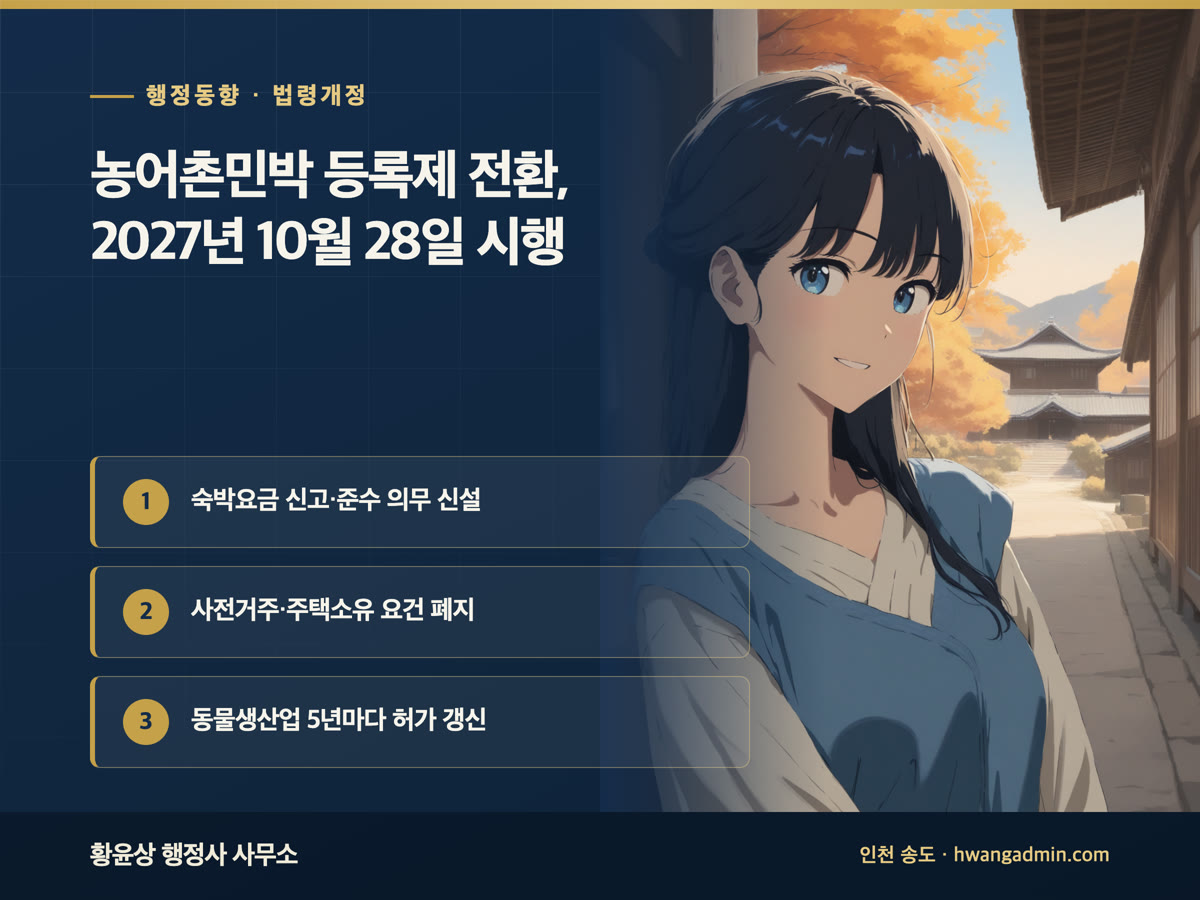
- Promulgation of the Amendment to the Act on the Promotion of Exchange between Urban and Rural Areas: Rural homestays change from a reporting system to a registration system; prior residency and homeownership requirements are abolished; mandatory reporting and compliance regarding accommodation fees; effective Thursday, October 28, 2027.
- Promulgation of the Amendment to the Animal Protection Act: 5-year permit renewal for animal breeding businesses; prohibition of non-operators donating or accepting animals for profit; effective Thursday, October 28, 2027.
- Korea Customs Service’s dedicated customs clearance platform for international direct purchases officially opens on October 26: Introduction of one-time authentication numbers for Personal Customs Clearance Codes and a registration system for e-commerce operators.
1. From Rural Homestay Reporting System to Registration System, and New Mandatory Reporting of Accommodation Fees

- What is changing: The amendment to the Act on the Promotion of Exchange between Urban and Rural Areas (Rural-Urban Exchange Act), which passed the National Assembly on October 1, was promulgated on October 27. As the provisions for rural homestays are moved from the Rural Community Restructuring Act to the Rural-Urban Exchange Act, the following changes will occur:
- Relaxation of entry requirements: Abolition of prior residency and homeownership requirements; standards for house size may be determined differently by local government ordinances (the upper limit on the number of guest rooms will be set by ministerial decree).
- Strengthened management: The reporting system will change to a registration system; registration may be canceled if registration standards are not met or laws are violated; new disqualification grounds such as sex offenders; mandatory labeling of “Rural Homestay” for online reservations and promotions.
- Fee regulation: Accommodation fees must be reported to the Mayor, County Governor, or Head of Gu and must be complied with; unilateral cancellation or change of reservations without justifiable reasons is prohibited (violations result in administrative fines or business suspension; selling at a higher price after cancellation results in a surcharge).
- Other: Institutionalization of the vacant house regeneration homestay business (mandatory assignment of a manager); succession of business status by an heir residing in the business premises upon the death of the operator; expansion of the scope of meal provision from breakfast to include lunch and dinner (meals other than breakfast are subject to the Food Sanitation Act).
- Who it applies to: Rural homestay operators, those preparing to open a homestay after moving to rural areas, and village enterprises or social cooperatives reviewing vacant house utilization businesses.
- Effective date: Effective Thursday, October 28, 2027 (one year after promulgation). As the registration standards, upper limits on the number of guest rooms, and amounts for administrative fines are to be determined by subordinate statutes, ⚠️ checking the original text is required.
- Administrative Agent’s Note: How existing reporting-based businesses will transition to the registration system (transitional measures) will be finalized once the Enforcement Decree and Enforcement Rule are released. If you are currently operating, please check your reporting certificate, the intended use on the building ledger, and the number of guest rooms in advance. For those planning to start a new business, it is advisable to check with your local city, county, or district office whether registration is possible after the effective date when residency requirements are removed.
- Source: Korea Policy Briefing · Ministry of Agriculture, Food and Rural Affairs: Promulgation of the Amendment to the Rural-Urban Exchange Act regarding the improvement of the rural homestay system (October 26)
2. Amendment to the Animal Protection Act: 5-Year Permit Renewal for Animal Breeding, and Regulation of New Types of Pet Shops

- What is changing: A partial amendment to the Animal Protection Act was promulgated on October 27. The details regarding business operations are as follows:
- Permit renewal system for animal breeding: Instead of being able to continue operations indefinitely once a permit is obtained, the system will change to a method where the extension of the permit is decided every five years by verifying facility and personnel standards.
- Regulation of new types of pet shops: Restrictions on pet business operators using trade names or advertising that are similar to animal protection centers; prohibition of non-operators donating or accepting animals for profit.
- Scope of animal abandonment: The act of not picking up an animal left at a consignment management facility (such as a pet hotel) or a veterinary hospital will also be considered abandonment.
- Duty of care and management: Administrative fines of up to 1 million won for violations of duties (e.g., leashes shorter than 2m, failure to provide rest areas during extreme heat or cold); courts may issue a ban on animal rearing for up to 5 years for serious abusers.
- Who it applies to: Animal breeding, sales, and consignment management business operators; adoption agencies using the name of a shelter; pet owners.
- Effective date: Effective Thursday, October 28, 2027 (one year after promulgation). The special case for the temporary use of farmland for other purposes by private animal protection facilities will take effect immediately upon promulgation.
- Administrative Agent’s Note: The timing of the first renewal for existing breeding businesses and the required renewal documents will be determined by subordinate statutes. Please check your current animal breeding permit date and whether you meet the facility and personnel standards, and if you are using terms like “shelter” or “center” in your trade name or advertisements, please check whether they need to be changed before the implementation.
- Source: Korea Policy Briefing · Ministry of Agriculture, Food and Rural Affairs: Promulgation of the Amendment to the Animal Protection Act (October 26)
3. Opening of the Dedicated Customs Clearance Platform for Overseas Direct Purchases and One-Time Authentication Numbers for Personal Customs Clearance Codes

- What is changing: The Korea Customs Service officially opened the dedicated e-commerce customs clearance platform on October 26, following its pilot operation that began on August 28. They have introduced a one-time authentication number system to prevent the theft of Personal Customs Clearance Codes and opened a dedicated e-commerce portal (ecos.customs.go.kr) where code management and customs duty payments can be handled in one place. For shopping malls, a registration system for e-commerce businesses and dedicated e-commerce reporting forms will be established. While goods with sufficient transaction information will undergo rapid customs clearance, high-risk goods that do not pass through the platform will face strengthened X-ray screening and inspections.
- Who it applies to: Consumers making overseas direct purchases, shopping malls and purchasing agents selling overseas goods to domestic consumers, and express logistics companies.
- Effective date: Officially opened on Monday, October 26, 2026. The specific timing for when one-time authentication numbers must be used and the scope of mandatory registration for e-commerce businesses requires ⚠️ verification of the original text.
- Administrative Agent’s Note: Business owners engaged in purchasing agency or import sales should check with the express logistics companies that handle their customs clearance to see if they are subject to e-commerce business registration and how the method for submitting transaction information will change. If consumers suspect their Personal Customs Clearance Code has been stolen, they can have the code reissued through the portal.
- Source: Korea Policy Briefing · Korea Customs Service Officially Opens Dedicated Customs Clearance Platform for Overseas Direct Purchases (October 26)
4. Departure Guarantee Insurance for Foreign Workers with Less Than One Year of Service Goes to the Employer

- What is changing: Regarding reports that the Departure Guarantee Insurance for foreign workers whose employment permit is canceled due to unpaid wages goes to the employer even if they have not completed one year of service, the Ministry of Employment and Labor released an explanatory document on October 26. The explanation states that the Act on the Guarantee of Employees’ Retirement Benefits does not impose an obligation to pay severance pay to employees with a continuous service period of less than one year (Article 4), and the Enforcement Decree of the Act on the Employment of Foreign Workers also stipulates that if the period of employment is less than one year, the lump-sum Departure Guarantee Insurance belongs to the employer (Article 21). The system itself has not changed, but the Ministry stated that it would review measures to reform the system to protect rights and interests.
- Who it applies to: Employers who employ foreign workers under the Employment Permit System (such as E-9), and foreign workers who change workplaces or depart the country before completing one year of employment.
- Effective date: Current standards (the reform plan is in the review stage; timing is undecided).
- Administrative Agent’s Note: Since the ownership of the Departure Guarantee Insurance is determined based on a one-year period of employment, you must accurately record the date of hire and the date of workplace changes. Whether wages have been unpaid for employees with less than one year of service is a matter to be settled separately from the ownership of the insurance, so please keep records of salary payment details organized.
- Source: Korea Policy Briefing · Ministry of Employment and Labor Press Briefing Material (October 26)
Deadlines to Note This Week
- October 27 (Tue): Promulgation of amended laws for the Rural-Urban Exchange Act and the Animal Protection Act (Effective October 28, 2027).
- Legislative Notice of Subordinate Statutes: Opinions can be submitted during the legislative notice period for the Enforcement Decrees and Enforcement Rules regarding the registration standards and room limits for rural homestays and the renewal procedures for animal breeding businesses (Timing ⚠️ requires verification of the original text).
This briefing is a guide organized by the Hwang Yunsang Administrative Agent Office based on public data. Application to individual cases requires verification with the competent authorities.